
More confidently. With greater awareness. With those we work with—and for—in mind.
For our support to be effective, goodwill alone isn't enough. It also requires knowledge, competence, and continuous development. Therefore, between one meeting and the next, between a project and a coffee conversation, it's sometimes worth pausing and exploring what might be useful. Not in theory, but in life. The way we experience it every day—full of people, emotions, and unpredictable situations.
That's why, although we're usually the ones doing the work, we've recently taken a step back. And allowed ourselves to learn. Because by developing ourselves, we strengthen the wings of the entire Foundation.
July is a month of important skills
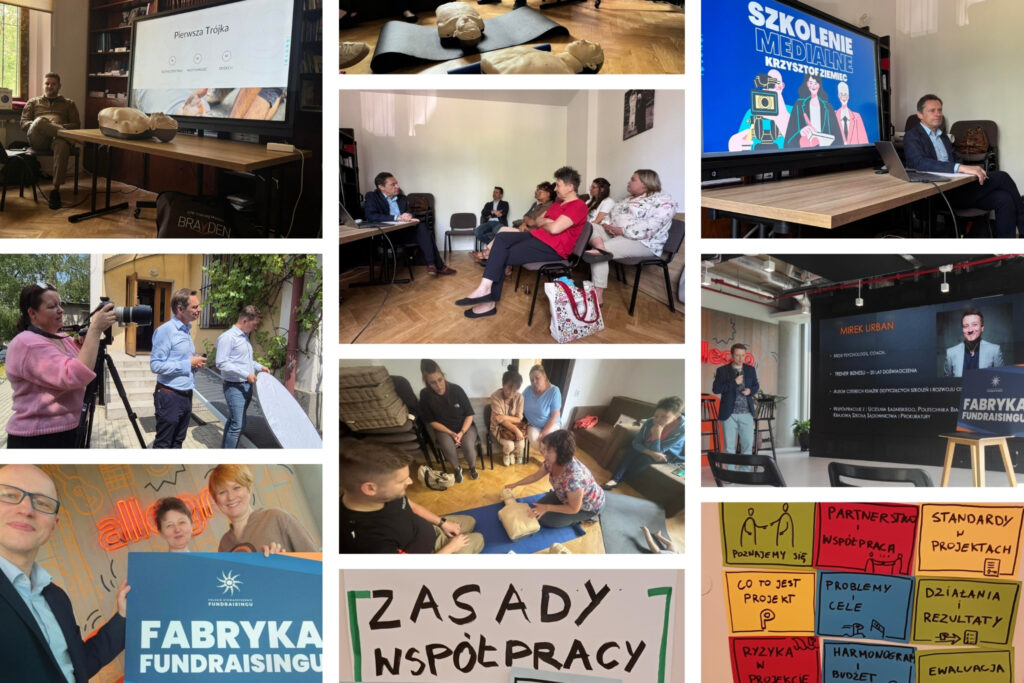
In mid-July, two very important training sessions took place: first aid and media training. We want to start with these two, as they showed us how crucial specific skills are – not only in our work but also in our everyday lives.
First aid – responsibility that gives strength
For us, this training wasn't just a "just in case" approach. It was a real need – because when organizing events, trips, or workshops, we know that responsibility for others doesn't end with good intentions.
Mr. Łukasz from Longlife.pl led the training for us. It was dynamic, practical, and very engaging. Thanks to him, we gained not only knowledge but also confidence in our ability to act when necessary. After all, our work involves numerous meetings and field activities – something unexpected can happen anywhere.
For us, knowing how to administer first aid is an expression of responsibility—to those around us. It also gives us peace of mind knowing we're prepared. And while we desperately wish this knowledge would never be needed, we know it's essential.
Media without bullshit – what you see, what you hear and what to remember
Mr. Krzysztof Ziemiec led our media training. It was an incredibly interesting experience – although we often talk about our work, projects, and the results of our activities, speaking in front of a camera is a completely different story.
We learned how to speak concisely, clearly, and authentically. How to behave in front of a camera, how to craft a message that resonates with people. Mr. Krzysztof demonstrated the importance of posture, tone of voice, and word choice—but also how the media works from the inside. How to read intentions, how to respond, and how to avoid getting lost.
Watching our videos together was emotional – some laughter, some stress – but above all, it allowed us to learn in an atmosphere of support. Because that's what we care about most – honesty, genuine connection, and stories that stay with us.
May: storytelling and international cooperation
July is a busy month, but in May we were already taking further steps in our development. We participated in two important training sessions – each different, each valuable.
The Fundraising Factory workshop, organized by the Polish Fundraising Association at Allegro's headquarters in the Norblin Factory, was a true lesson in storytelling. The presenter, Mirosław Urban, with ease and precision, showed us how to use storytelling to convey our work, build trust, and encourage support for those we support.
Good stories have power. And that's why it was so important for us to learn how to create them—not for show, but from the heart. To show people that helping others makes sense and brings real change. We wrote more about this meeting. here.
The second training session – a three-day workshop organized by the Education for Democracy Foundation – focused on the preparation and implementation of international partnership projects. It was practical: how to transform an idea into a meaningful plan, how to describe what we want to do so that it has a realistic chance of being implemented. We also discussed the challenges that can arise along the way – and what really helps to anticipate them or navigate them successfully. All of this was firmly rooted in reality, not the ideal world of textbooks.
Why do we do this?
We train because we want to do our jobs well – make smarter decisions, speak more carefully, act more effectively. Each training session focused on a different area, but they all had one thing in common: "responsibility." For what we say. For what we do. For those with whom and for whom we work. Each such session provides not only new knowledge but also an opportunity to look at what we do – from a different perspective.
We don't have to be experts in everything. But we want to be reliable in what we do. Because this often determines not only the quality of our work but also safety, relationships, and the way we interact with people. And that's simply what we care about. The skills we acquire simply stay with us. And they return when we need them most.
We'd like to thank all the coaches, organizations, and individuals who share their experience with us. Thanks to you, we can "spark" even more.